By setting up the Shopgate plugin for your OXID shop, you can benefit from numerous features:
| Support | Import to OXID | ||
| Version | 4, 5 and 6 | Orders | ✔ |
| Customer account | Export to Shopgate | ||
| Login with desktop shop account | ✔ | Products | ✔ |
| Login with mobile account | ✔ | Categories | ✔ |
| Customer groups/tier prices | ✔ / ✔ | Reviews | ✔ |
| Show desktop order history on mobile | ✔ | ||
| Sync | Check for changes in the shopping cart | ||
| Delivery status "shipped" | ✔ | Coupon | ✔ |
| Order status "cancelled" | ✔ | Shipping methods | ✔ |
| Stock (product detail page) | ✔ | Payment methods* | ✔ |
| Product availability | ✔ | ||
| Supported payment methods | Notes | ||
|
Shopgate, PayPal, PayPal Plus, cash on delivery, prepayment, invoice, direct debit, Payolution, PayOne (credit card, PayPal, SOFORT bank transfer) |
* This feature validates and shows all payment methods that are valid for the customer and the shopping cart, based on the rules in the shop system. If you want to use this feature, please contact Shopgate support. |
Installing the Shopgate plugin
The Shopgate plugin can be installed for all shops running OXID version 4.2.0 or later. Upload the plugin to your OXID folder and activate it in your OXID admin. To do this, proceed as follows:
Downloading the plugin
Download the latest plugin "shopgate-oxid-integration.zip" here and extract the zip file. This gives you an "OXID" folder with two subfolders: Ab_eShop_4.7 (OXID eShop versions 4.7.0 and later) and Bis_eShop_4.6 (OXID eShop versions 4.2.0 to 4.6.x)
Uploading the plugin to the server
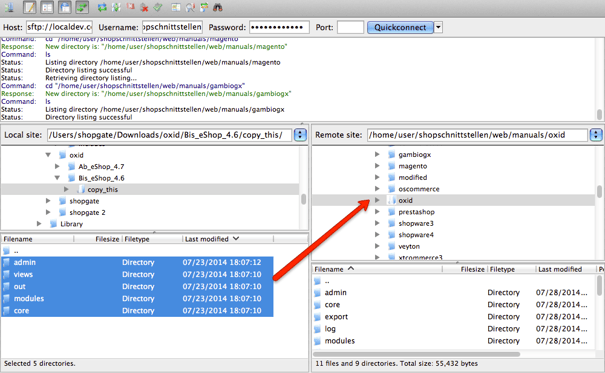
- Use an FTP program such as FileZilla to copy the plugin to your "OXID eShop".
- Once the FTP program is connected to your server, go to the location of the extracted Shopgate plugin.
- Depending on your OXID shop version, select "Ab_eShop_4.7" or "Bis_eShop_4.6".
- In this folder, open “copy_this”. Copy its entire content to the root directory of the OXID installation on your server. Do not close your FTP program – you will need it again later.
Setting file permissions
You need to set the permissions for the "temp" and "config" folders on your server:
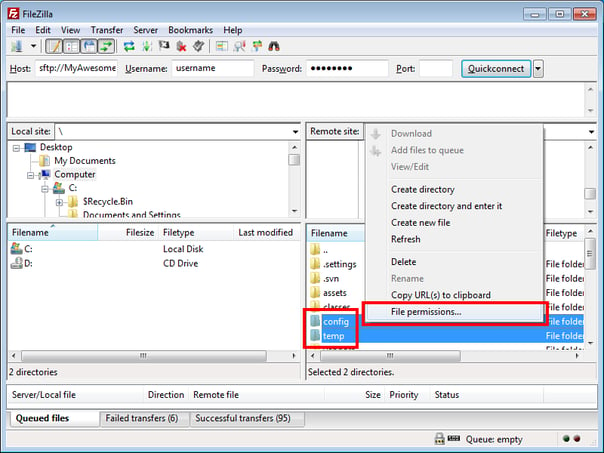
- Go to the folder "modules/shopgate/shopgate_library" on your server and select temp and config. Then right-click your selection and choose the option File permissions.
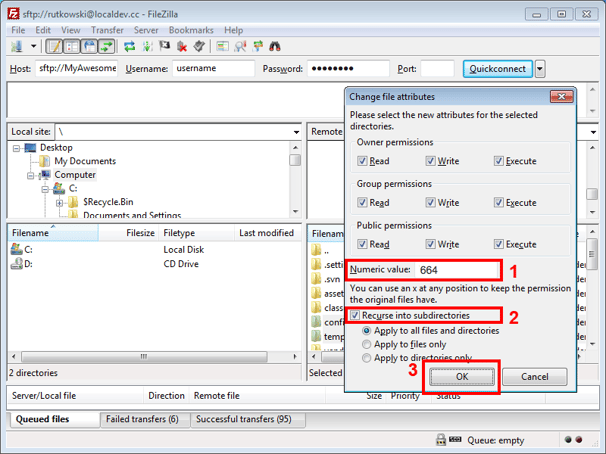
- The "Change file attributes" dialog opens. Enter the digits 664* in the input field. Make sure that the checkbox "Recurse into subdirectories" is ticked and "Apply to all files and directories" is selected. Click OK.
* If your settings or changes cannot be saved, please set the access permissions to the value (777).
The Shopgate plugin has been installed successfully and is now ready to be activated.
Activating the plugin in OXID
To activate the Shopgate plugin in your OXID backend, log in to your OXID admin and continue according to your OXID version:
OXID 4.6 and later OXID 4.5 OXID 4.4 and earlier
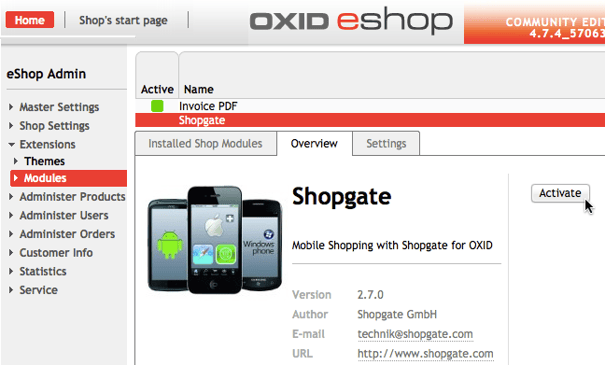
- In the main menu on the left, go to Extensions → Modules.
- Select Shopgate from the list of extensions.
- Then click the Overview tab in the lower part of your screen if it is not open yet.
- Click the Activate button to activate the Shopgate plugin.
- With this step, you have activated the plugin. Continue with the section "Establishing the connection"; you can skip the section "Clearing OXID's "temp" folder".
- In the main menu on the left, click Master Settings → Core Settings. Switch to the System tab. Click the Modules section to
expand it.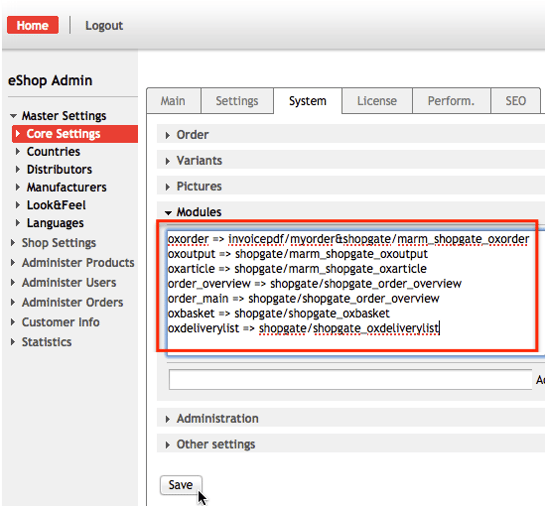
- Enter the following data in the text field "Installed Shop Modules":
order_main => shopgate/shopgate_order_overview
order_overview => shopgate/shopgate_order_overview
oxarticle => shopgate/marm_shopgate_oxarticle
oxbasket => shopgate/shopgate_oxbasket
oxdeliverylist => shopgate/shopgate_oxdeliverylist
oxorder => shopgate/marm_shopgate_oxorder
oxoutput => shopgate/marm_shopgate_oxoutput
oxsession => shopgate/shopgate_oxsession
oxvarianthandler => shopgate/shopgate_oxvarianthandler - If module entries already exist, add the corresponding value with an "&". For example, "oxorder" (line 7) already exists:
oxorder => invoicepdf/myorder
Change it to:oxorder => invoicepdf/myorder&shopgate/marm_shopgate_oxorder
- With this step, you have activated the plugin. Now go to the section "Clearing OXID's "temp" folder".
- In the main menu on the left, click Master Settings → Core Settings. Switch to the System tab. Click the Modules section to expand it.
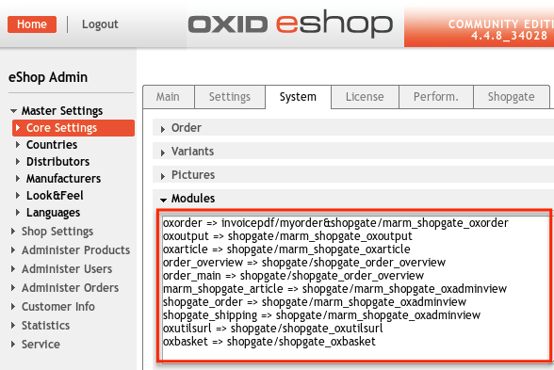
- Enter the following data in the text fields under "Installed Shop Modules":
marm_shopgate_article => shopgate/marm_shopgate_oxadminview
order_main => shopgate/shopgate_order_overview
order_overview => shopgate/shopgate_order_overview
oxarticle => shopgate/marm_shopgate_oxarticle
oxbasket => shopgate/shopgate_oxbasket
oxdeliverylist => shopgate/shopgate_oxdeliverylist
oxorder => shopgate/marm_shopgate_oxorder
oxoutput => shopgate/marm_shopgate_oxoutput
oxsession => shopgate/shopgate_oxsession
oxvarianthandler => shopgate/shopgate_oxvarianthandler
shopgate_order => shopgate/marm_shopgate_oxadminview
shopgate_payment => shopgate/marm_shopgate_oxadminview
shopgate_shipping => shopgate/marm_shopgate_oxadminview - If module entries already exist, add the corresponding value with an "&". For example, "oxorder" (line 7) already exists:
oxorder => invoicepdf/myorder
Change it to:oxorder => invoicepdf/myorder&shopgate/marm_shopgate_oxorder
- With this step, you have activated the plugin. Now go to the section "Clearing OXID's "temp" folder".
Clearing OXID's "temp" folder
Please note that you need to delete the content of the "temp" folder in OXID before you continue:
- Go back to your open FTP program, find the "tmp" folder in your OXID installation and open it.
- If you find a file called ".htaccess", select all files in the folder except ".htaccess" and delete them. If this file does not exist, delete all files in the folder.
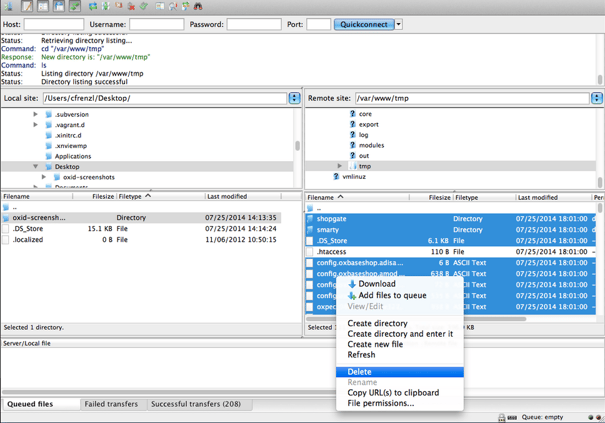
- With this step, you have successfully cleared the "tmp" folder.
Establishing the connection
Once the Shopgate plugin has been installed, only a few steps are needed to establish the connection.
Finding your API credentials
- Log in to your Shopgate Admin.
- Click Settings › Shop Interface.
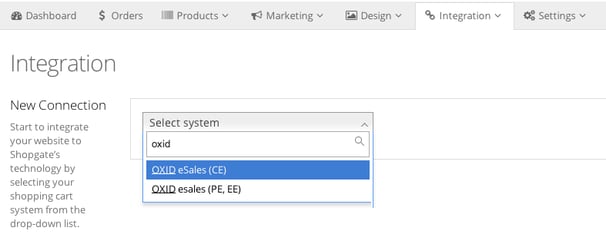
- Go to the "New connection" section and, in the drop-down menu "Select system", search for OXID eSales. Select the version that matches your shop edition (CE = Community Edition, PE = Professional Edition, EE = Enterprise Edition).
- In the pop-up window that opens, you will find your API credentials under "2. Configure", which are needed to activate your plugin. They include the customer number, shop number, API key and alias. Keep this pop-up open as well. You will enter your URL here later (see "Connecting your shop to Shopgate").
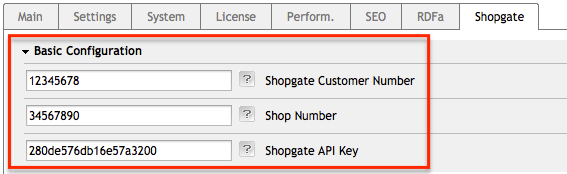
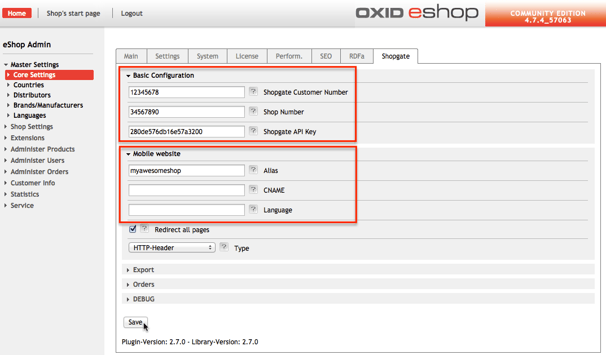
- Open your OXID admin in another tab/browser window (if the page from installing the plugin is no longer open). In the main menu on the left, click Master Settings → Core Settings and then the "Shopgate" tab. Expand the sections "Basic Configuration" and "Mobile Website" by clicking them. Enter your API credentials (customer number, shop number, API key and alias) from your Shopgate Admin in the text fields. The other options can be edited later (see "Configuring the plugin"). Finally, click Save to apply your settings.
Connecting your shop to Shopgate
- Switch back to the pop-up window in your Shopgate Admin.
- Under "3. Enter URL", enter the URL of your online shop, ideally starting with "https://", e.g. https://www.MyAwesomeShop.com.
- Then click Connect to set up the interface.

- As soon as the connection has been established successfully, another pop-up window opens. Here you can set up the jobs for the first connection. We recommend leaving these settings enabled (set to "ON") for now. Finally, click Save to apply the settings.
After saving, the import of your product data via the Shopgate plugin starts automatically.
Updating the plugin
Checking for customizations
Before you start updating your Shopgate plugin, please check whether your shop uses a customized version of the Shopgate plugin. If so, a newer plugin will NOT work in your shop.
How can I check whether my shop uses a customized plugin? |
You are using a customized plugin version in the following cases:
|
What do I need to do if my shop uses a customized plugin? |
Please contact Shopgate by email before every update and provide these details:
|
Updating the plugin
To update an already installed Shopgate plugin to the latest version, please follow these steps.
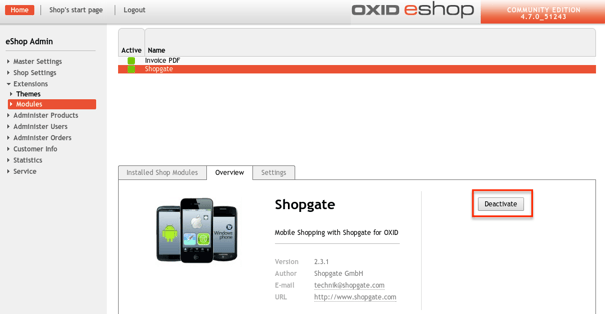
- First deactivate the plugin currently running. From OXID version 4.6, go to Extensions → Module in the left menu of your OXID admin. Next, select Shopgate from the list. Then click Overview and then the Deactivate button.
- Download the latest version:
To update a generic Shopgate plugin, download the latest version.
To update a customized Shopgate plugin, download the latest version that you receive by email. - Install and activate the Shopgate plugin.
Your plugin has been updated successfully.
Configuring the plugin
To configure your plugin, go to Master Settings → Core Settings in your OXID admin. Click the Shopgate tab.
Here you can configure your Shopgate credentials. They are needed to connect your shop to Shopgate.
| Shopgate customer number | Your customer number at Shopgate |
| Shopgate shop number | Your shop number at Shopgate |
| Shopgate API key | Your API key at Shopgate |
Frequently Asked Questions
After installation, a "system health check" notice appears – what does it mean?
This notice is shown if the collations of the ID fields do not match (see images below).


To fix this error, go to Service → Tools and run the following SQL command.
- For systems using ISO:
ALTER TABLE `oxordershopgate` CHANGE `OXID` `OXID` CHAR( 32 ) CHARACTER SET latin1 COLLATE latin1_general_ci NOT NULL;
ALTER TABLE `oxordershopgate` CHANGE `OXORDERID` `OXORDERID` CHAR( 32 ) CHARACTER SET latin1 COLLATE latin1_general_ci NOT NULL;
ALTER TABLE `oxordershopgate` CHANGE `order_number` `order_number` VARCHAR( 20 ) CHARACTER SET latin1 COLLATE latin1_general_ci NOT NULL; - For systems using UTF-8:
ALTER TABLE `oxordershopgate` CHANGE `OXID` `OXID` CHAR( 32 ) CHARACTER SET utf8 COLLATE utf8_general_ci NOT NULL;
ALTER TABLE `oxordershopgate` CHANGE `OXORDERID` `OXORDERID` CHAR( 32 ) CHARACTER SET utf8 COLLATE utf8_general_ci NOT NULL;
ALTER TABLE `oxordershopgate` CHANGE `order_number` `order_number` VARCHAR( 20 ) CHARACTER SET utf8 COLLATE utf8_general_ci NOT NULL;
How can I tell whether my OXID uses UTF-8 or ISO?
In the table under Service → System Info , look for the entry iUtfMode.
In the column on the right, you will find the digit 0 or 1.
- If it shows 1, your system uses UTF-8.
- If it shows 0, your system uses ISO.
I have several shops in my OXID Enterprise account. Can I create a separate app for each shop?
Yes, you can set up a separate app for each of your shops.
To do this, go to your OXID backend, select the shop you want and enter your Shopgate credentials there, as shown below.