
Once you have set up the Shopgate plugin in your JTL backend, you benefit from a range of features that are carried over directly into your app:
| Support | Import to JTL Software | ||
| Version | 4 & 5 | Orders | ✔ |
| Customer account | Export to Shopgate | ||
| Login with desktop shop account | ✔ | Products | ✔ |
| Login with mobile account | ✔ | Categories | ✔ |
| Customer groups/tier prices | ✔ / ✔ | Reviews | ✔ |
| Show desktop order history on mobile | ✘ | ||
| Sync | Validate on cart changes | ||
| Delivery status "shipped" | ✔ | Coupon | ✔ |
| Order status "cancelled" | ✔ | Shipping & costs | ✔ |
| Stock quantity (product detail page) | ✔ | Product availability | ✔ |
| Supported payment methods | Notes | ||
|
JTL has its own process for mapping your payment methods. |
The plugin is maintained by our external developer Andreas Guder. If you have questions about the plugin, please contact him: http://www.andreas-guder.de/agi-software/jtl-shop3.html |
Installing the Shopgate plugin
To install the Shopgate plugin, proceed as follows:
- Copy the complete directories "includes", "shopgate_library" and "shopgate_request" via FTP into the root directory of your shop. (Your root directory also contains the folders "admin", "bilder" and "classes", among others.)
- Find the Shopgate plugin in the plugin management (Pluginverwaltung) of your shop and install it.
- Enter the licence key "test" to use the plugin without restrictions for 14 days. After 14 days, you need an individual licence key to continue using the plugin. You can request it from our external developer Andreas Guder (http://www.Andreas-Guder.de/bestelle-jtlshop-shopgate-lizenz.html).
Configuring the plugin
To set up your plugin, you need to adjust a few things in your JTL backend. Simply follow the steps below:
Finding your API credentials at Shopgate
- Log in to your Shopgate admin.
- In the menu bar, click Settings › Shop Interface.
- In the "Select a system" drop-down menu, search for JTL and select it from the list.
- A pop-up window then opens. Under "1. Configure", you will find your API credentials: customer number, shop number, API key and alias. Keep the pop-up window open for now, as you will need it again later to enter your URL.
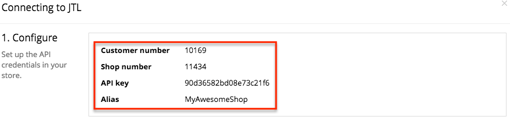
Entering your API credentials in JTL
- Log in to your JTL admin.
- In the menu bar, go to Plugins → Plugins and then select Shopgate Plugin (AGI Plugin).

- On the page that opens, go to the API-Einrichtung tab. If you see a message that the following directories are not writable, grant write permissions via your FTP program or web interface:
- shopgate_library/temp/
- shopgate_library/temp/cache/
- shopgate_library/temp/logs/
- shopgate_library/config/
Open the menu again and repeat the process until all messages about "not writable" directories have disappeared. - Now enter your API credentials (customer number, shop number, API key and alias) and then click Speichern (Save).
IMPORTANT: Leave the setting "Mobile-Weiterleitung aktivieren" (activate mobile redirect) turned off.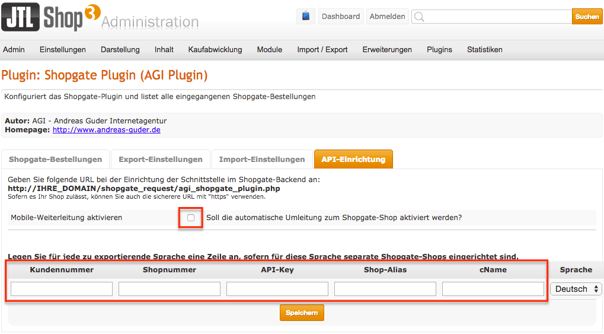
Editing import and export settings
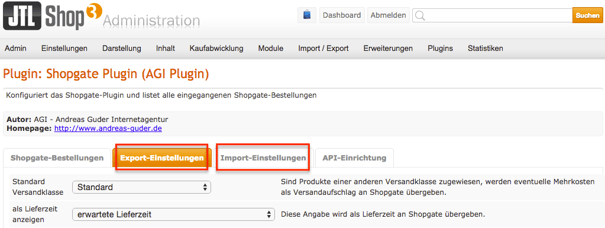
In your JTL admin, go to Plugins → Plugins → Shopgate (AGI Plugin). There you can adjust the export and import options as you like via the corresponding tabs.
- "Export-Einstellungen" tab: Here you configure the product export. Your products are carried over into your app together with the categories they are assigned to.
- "Import-Einstellungen" tab: Here you configure the import of orders that are sent from your app to your shop backend. To edit your payment methods on this page, please follow the instructions in "Mapping payment methods".
If you have questions or run into problems during setup, please refer to the instructions on this page: http://wiki.jtl-software.de/index.php?title=Kategorie:Shop-FAQ
Establishing the connection
Enter the URL of your shop at Shopgate to establish the connection. Follow these steps:
- Go back to the pop-up window in your Shopgate admin that you kept open earlier.
- Under "2. Enter URL", enter the URL for the order connection to your shop. Then click Connect. The text field should look something like this: "http://YOUR_DOMAIN/shopgate_request/agi_shopgate_plugin.php". For the Shopgate test shop "My Awesome Shop", for example, you would enter the following URL:
http://myawesomeshop.com/shopgate_request/agi_shopgate_plugin.php
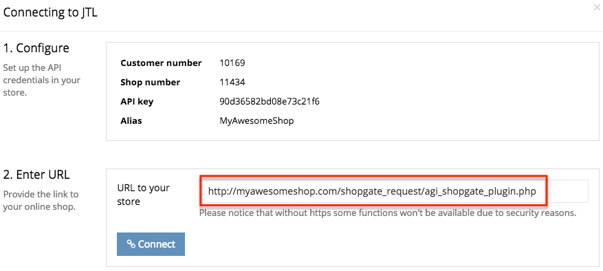
- If the connection was established successfully, the pop-up window shown below opens. Leave the options enabled (set to "ON") and click Save.
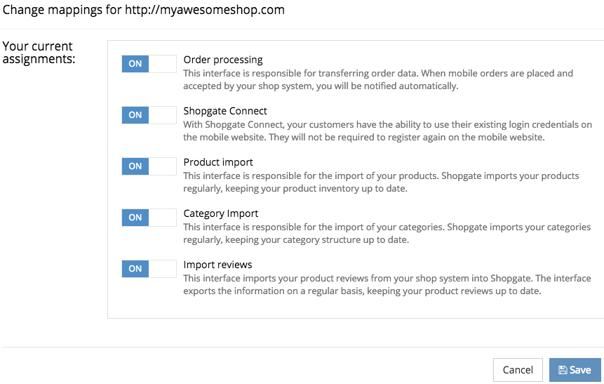
Once you have completed these steps, you have successfully connected the plugin to your shop! As soon as the import is complete, which you can tell from the progress bar no longer being visible, your products can be viewed in the app.
That's it – welcome to the mobile world!
Mapping payment methods
Under "Import-Einstellungen", you will find all payment methods supported by Shopgate ("Shopgate" column). The payment methods supported for your shop system are listed in the drop-down list ("Shop" column).
- To map the payment methods, look for the payment methods used in your app and select a corresponding payment method from the drop-down list.
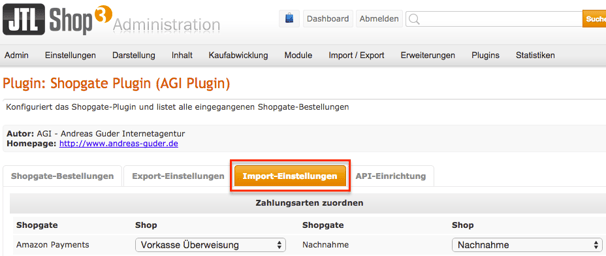
- If you use the Shopgate payment methods, select "Shopgate" in the section "Zahlungsart "Shopgate" zuordnen". Configure additional settings if needed and then click Speichern (Save).
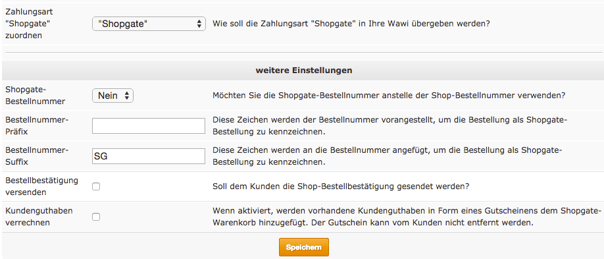
You have now mapped your payment methods and carried them over into your app.
Notes
The plugin is maintained by our external developer Andreas Guder. If you have questions about the plugin, please contact him: http://www.andreas-guder.de/agi-software/jtl-shop3.html